





Pixton for Math: Make Mathematical Thinking Visible
Pixton is a multimodal writing platform that helps students model problems, explain reasoning, apply math vocabulary, compare solution strategies, and demonstrate understanding. Students combine words, numbers, equations, and visuals to show how they think, not just the answer.
What’s Inside Pixton’s Interactive Math Lessons
Pixton has tools and ready-to-use resources for multimodal math writing, problem solving, explanation, and assessment.
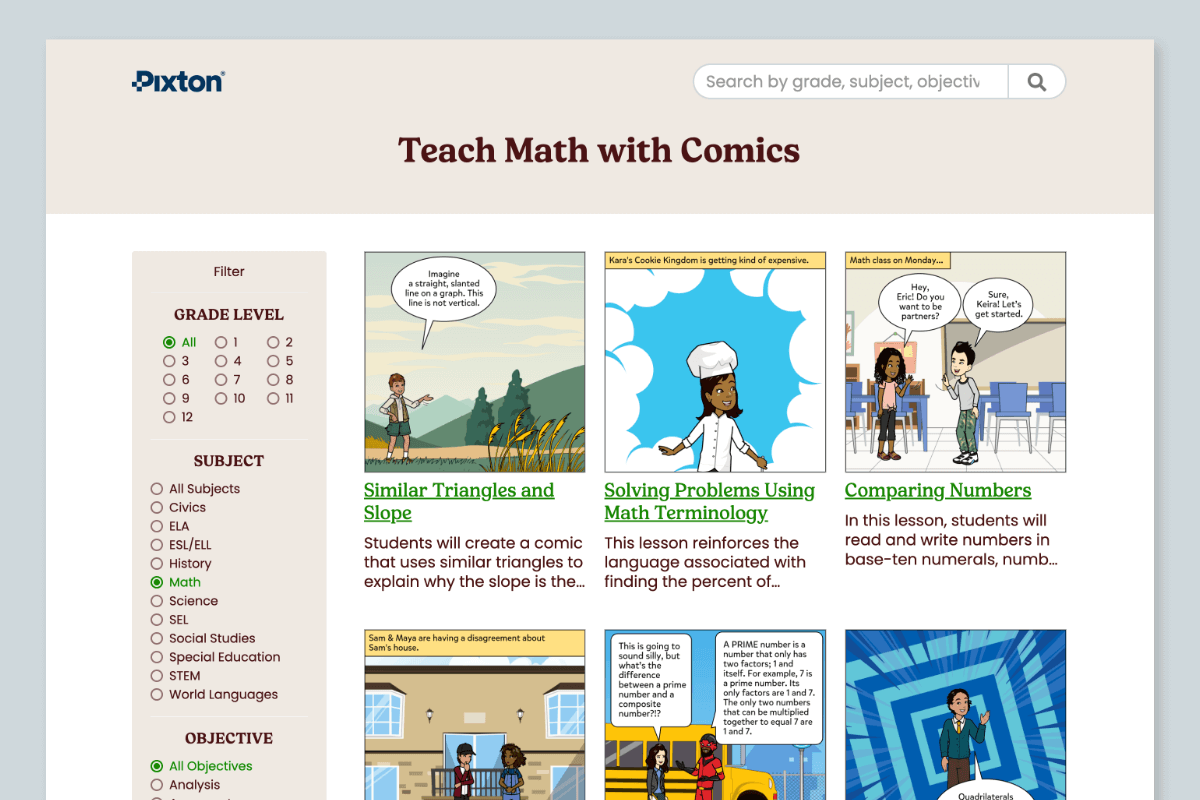
Math Lesson Ideas
Featured Content and Story Starters
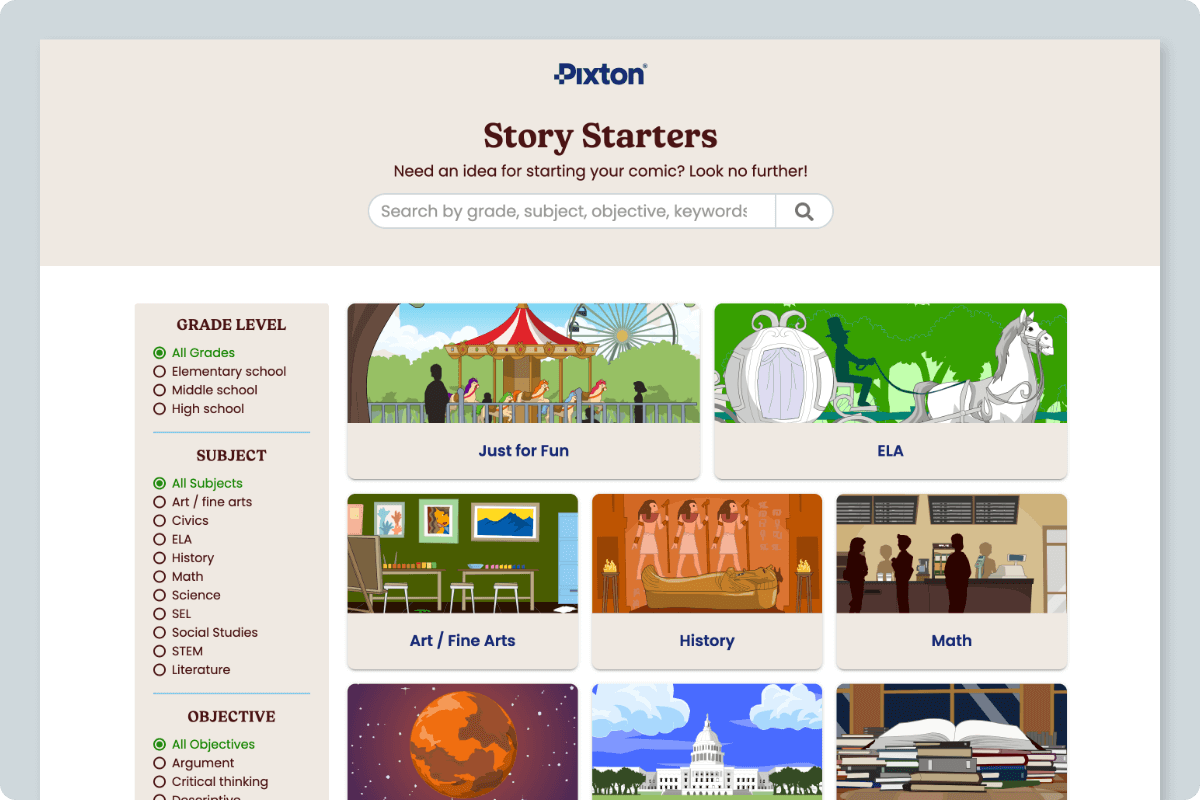
Pixton’s Featured Content gives students characters, settings, objects, and other visuals they can use to place mathematics in meaningful contexts.
Story Starters provide another way to begin. Students might create and solve a word problem, explain an error, represent a mathematical relationship, compare two solution strategies, or show how math applies to a real-world situation.
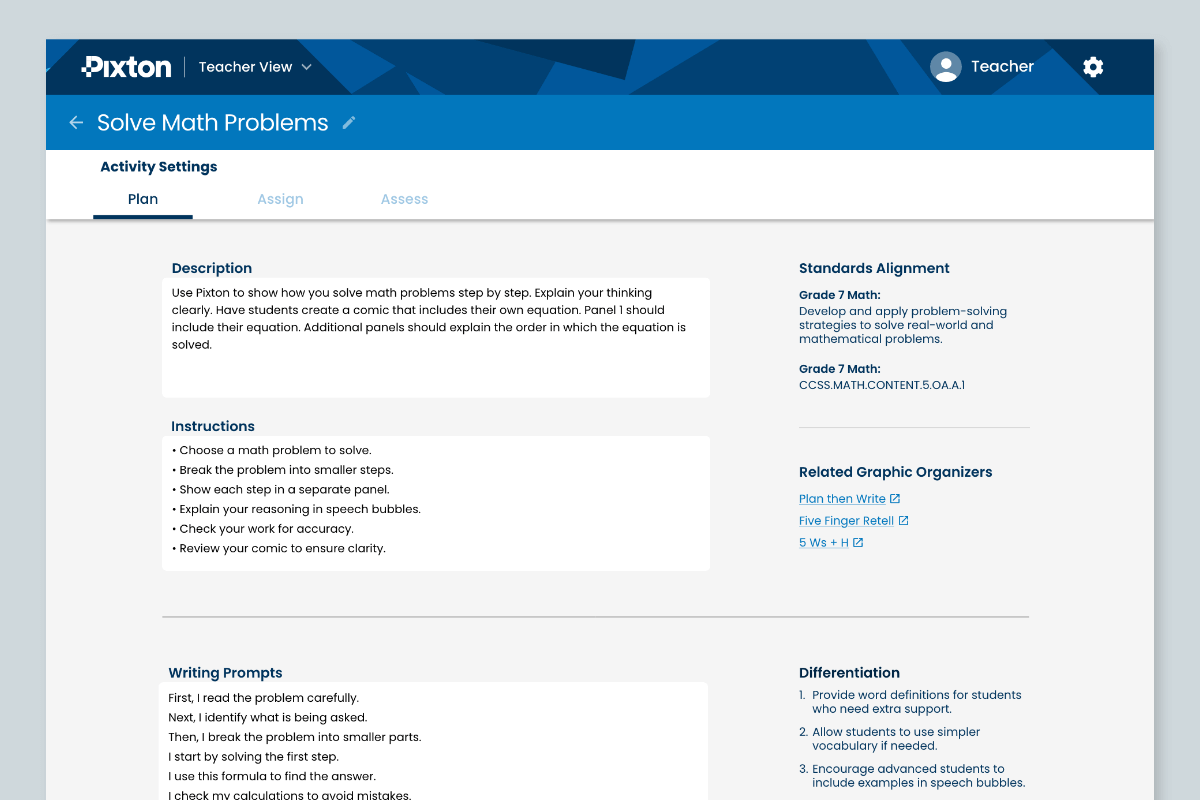
Activity Maker
Create a math writing, problem-solving, or assessment activity in minutes with Pixton’s Activity Maker. Enter a mathematical concept, skill, or learning goal and generate an activity students can use to model, solve, explain, compare, or demonstrate understanding.
For supported standards, including Common Core Math, teachers can also create standards-connected activities.
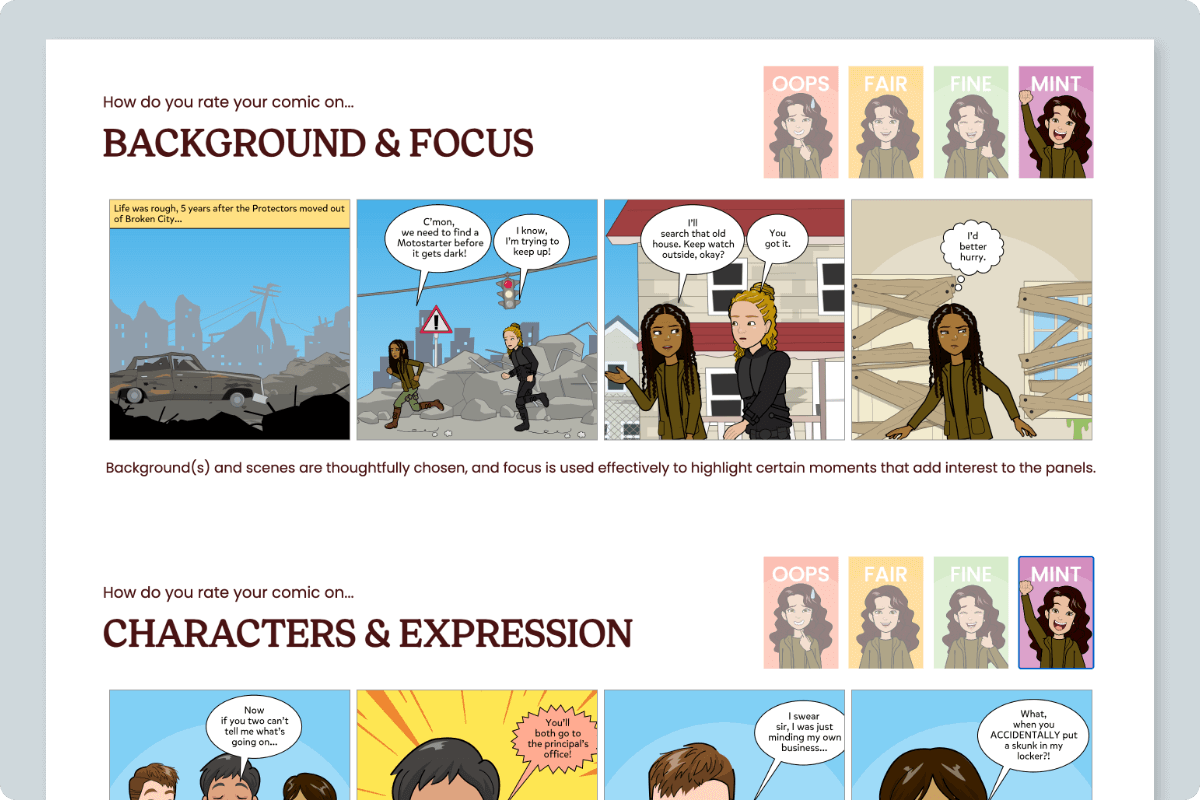
Interactive Rubric

Assess Multimodal Math Work
| The student decides | You can see |
| What order the panels go | Sequence and mathematical reasoning. Whether the steps follow logically and the student understands how one part of the solution leads to the next. |
| What the characters say | Mathematical vocabulary, explanation, justification, and reasoning in the student’s own words. Whether they can explain how and why a solution works. |
| What appears in each panel | Numbers, equations, diagrams, quantities, models, examples, mathematical accuracy and whether the representation matches the concept or problem. |
| How things change between panels | Operations, transformations, relationships, and cause and effect within the solution. Whether the student understands what changed and why. |
| Which strategies and representations they use | Conceptual understanding and strategy selection. Whether students can choose useful representations and connect words, visuals, numbers, and symbols to communicate their thinking. |
Why Use Pixton for Math?
-

Show Reasoning, Not Just Answers
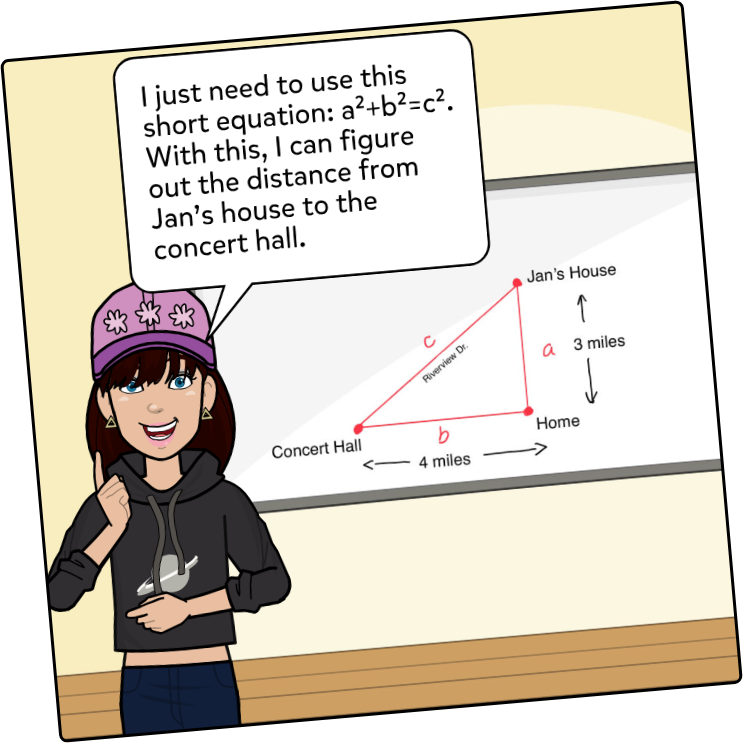
Pixton gives students a structured way to explain how they solved a problem. Each panel can capture a step, representation, or decision, helping teachers see the reasoning behind the answer and identify misconceptions more easily. -

Make Abstract Math More Concrete
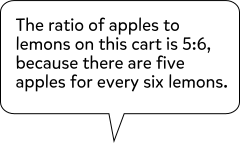
Students combine mathematical notation with words, diagrams, visual models, and real-world situations to represent concepts such as fractions, ratios, geometry, patterns, algebra, measurement, and data. -

Designed to Make Your Day Easier
Start with ready-to-use Lesson Ideas, Featured Content, Story Starters, rubrics, and the Activity Maker instead of building every math activity from scratch.
Pixton can support anything from a quick check for understanding to repeated opportunities for students to explain their mathematical thinking throughout a unit.
Why Pixton Works for Math


Pixton gives students another way to demonstrate mathematical understanding by combining explanation, visual representation, sequencing, and problem solving. Instead of seeing only a final answer, teachers can see how students approached the problem, represented mathematical relationships, and communicated their reasoning.
Pixton is also backed by independent validation and research into multimodal learning, writing, comprehension, and student engagement. Pixton meets ESSA Tier 2 evidence standards and has earned Digital Promise certifications for Research-Based Design and Learner Variability.
Ready to Make Mathematical Thinking Visible?
Help students model, solve, explain, and show what they know with Pixton.